
The Oldest Temptation
AI, TRANSHUMANISM, AND THE QUESTION OF WHAT IT MEANS TO BE HUMAN

One of the things that stands out to me about all the discussion surrounding artificial intelligence is not the technology itself. It is the hubris with which some people speak about it.
To be clear, there are countless applications for large language models and other adaptive systems that have nothing to do with transhumanism. They can become useful tools in medicine, education, engineering, research, and any number of other disciplines. I have no desire to reject every technological advancement simply because it is new.
What interests me is something much deeper than AI.
It is the growing conviction among many of the movement’s most influential thinkers that humanity itself is a problem to be solved.
From my reading, listening, and observation, it seems clear that enormous intellectual and financial resources are being devoted to solving what many describe as the problem of mortality.
That phrase alone reveals a great deal.
I do not personally view mortality as a problem. I view it as the next step in the human journey. That difference in perspective is not simply theological; it is foundational. Before we can intelligently discuss whether humanity should transcend death, we first have to answer a more basic question.
What is a human being?
The answer to that question determines every other conclusion that follows.
Terror Management Theory (TMT) suggests that much of human behavior is ultimately motivated by our awareness of death. I’ve mentioned it several times in my latest articles because I believe it is poorly applied as a pedantic way of sidestepping any legitimate debate about spirituality. According to TMT, we fear our inevitable end, so we create psychological mechanisms to suppress that fear or distract ourselves from it. Whether one accepts the theory in its entirety is almost beside the point. It correctly recognizes that our beliefs about death shape the way we live.
Where it also falls short, in my estimation, is assuming that death is universally perceived as something requiring escape.
For the Christian, death is neither desirable nor ultimate. It is an enemy, but a defeated one. It is not the end of the story. If death is merely a doorway into eternity, then the project of eliminating it begins to look very different than if one believes consciousness simply ceases.
This is why I have little interest in rehashing the entire debate between materialism and Christianity. Others have done so far more thoroughly than I could in a single article. Instead, I simply want to acknowledge that these worldviews begin with radically different assumptions about reality.
Within a materialist framework, humanity is ultimately the product of unguided physical processes. Consciousness emerges from matter. Reason emerges from chemistry. Morality develops as an evolutionary adaptation. Human beings become extraordinarily sophisticated biological organisms produced without intention or transcendent purpose.
If that is true, then it follows naturally that the body is fundamentally a machine. Death becomes system failure. Consciousness becomes information. The logical next step is to repair the machine, replace the damaged components, or eventually transfer the information somewhere more durable.
Transhumanism is not an accidental philosophy. It is the logical technological expression of materialism.
The Christian worldview begins somewhere entirely different.
Human beings are not accidents.
They are image bearers.
If humanity is fundamentally spiritual rather than merely biological, then every attempt to solve the human condition through engineering alone is destined to remain incomplete.
Technology can prolong life, restore function, and reduce suffering. It cannot answer the questions that make us human: Why do we exist? What is good? What is beautiful? What is worth sacrificing for?
No machine has ever loved, repented, worshipped, or forgiven because those are not computational problems. They are moral and spiritual realities.
Life is not valuable because we collectively decided that it should be. It possesses intrinsic value because its Author declared it so.
Those are very different foundations upon which to build civilization.
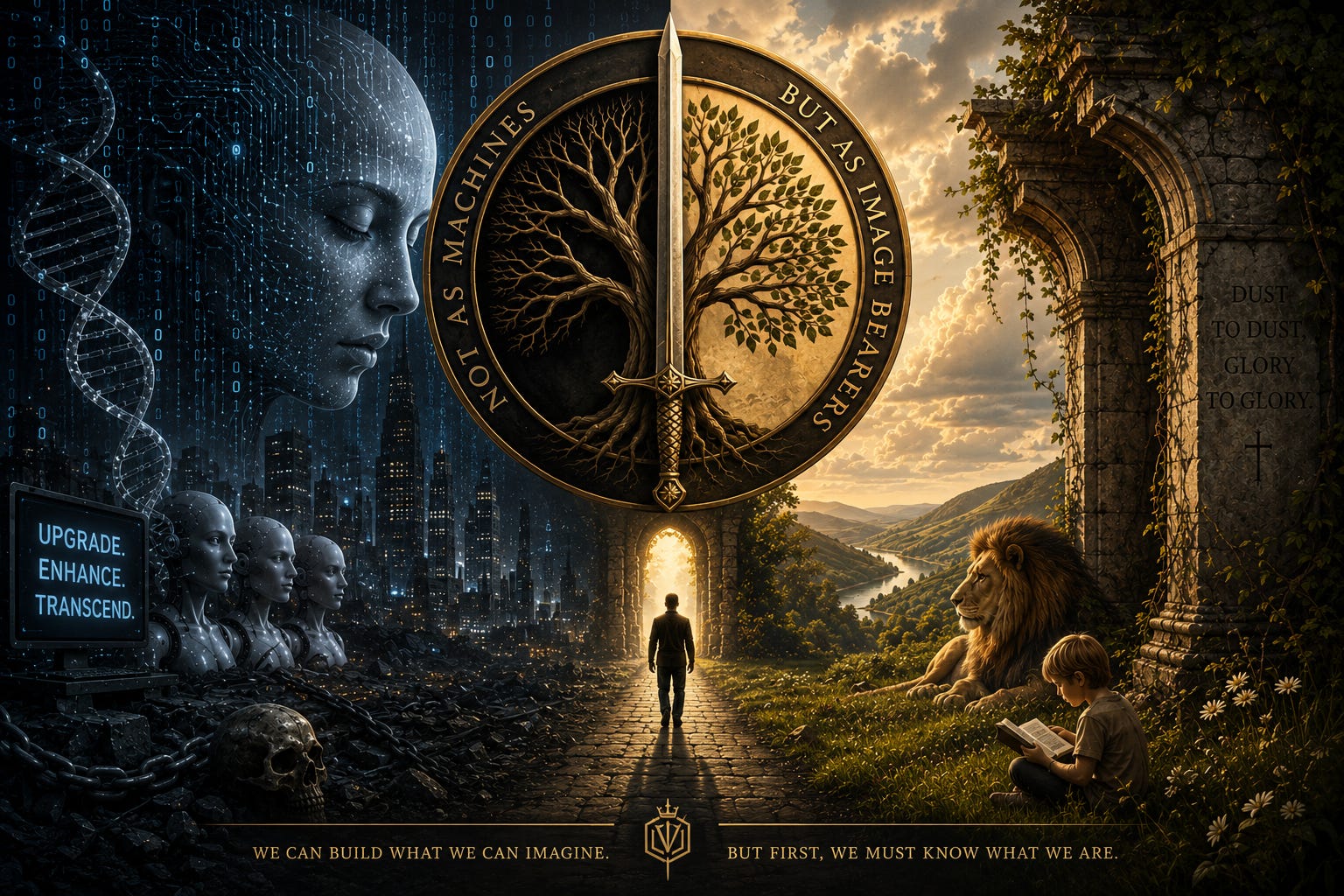
I often hear people describe the human body as a biological machine. While I understand why the analogy is attractive, I am not convinced that it is nearly as self-evident as many assume.
We compare the heart to a pump. The brain becomes a computer. DNA becomes software. Neurons become electrical circuits.
These metaphors can be incredibly useful for explaining complicated biological systems.
The danger comes when metaphors quietly become assumptions. We have always understood unfamiliar things through analogy. That is one of humanity's greatest strengths. The problem comes when our analogies cease being descriptive and begin becoming literal. Once that happens, our metaphors begin dictating our philosophy.
Before long, we stop saying the brain is like a computer and begin insisting that it is a computer.
Those are not the same statement.
Our growing technological sophistication has convinced many of us that we understand the human body far better than we actually do.
This may surprise readers who have never worked in healthcare. It may offend some who have. Modern medicine has achieved extraordinary successes, but those successes have sometimes produced an illusion of comprehensive understanding. We claim to know so much more than we do. In our arrogance at the successes we have seen, we have blinded ourselves to the damage that we cause.
The more we discover, the more we uncover entire worlds of complexity we previously never imagined existed.
Our understanding of the microbiome continues to evolve. Our understanding of autoimmune disease continues to change. Nutritional science reverses itself with surprising regularity. Psychiatry remains filled with unanswered questions. We continue discovering new cellular interactions, new hormonal pathways, and new mechanisms underlying disease.
That is not an indictment of the goals of medical professionals, though it is one of the industry of medicine.
It is also a reminder that reality is often far more complicated than our current models.
The greatest scientists I have known never claimed certainty.
They reveled in their curiosity.
This is one reason I become skeptical whenever someone confidently predicts that human consciousness will soon be uploaded into a computer or that immortality is simply an engineering problem awaiting sufficient computational power.
That confidence seems wildly disproportionate to what we actually know.
There is another question that has lingered in my mind for years, one that I have never heard materialism answer satisfactorily.
If our minds are nothing more than the unintended products of evolutionary processes concerned primarily with survival, why should we assume they are reliable instruments for discovering truth?
Natural selection rewards successful adaptation.
It does not necessarily reward accurate metaphysical beliefs.
A false belief that increases reproductive success is entirely compatible with evolutionary theory.
So how do we know our reasoning faculties are actually oriented toward truth rather than merely toward survival?
This is not merely an abstract philosophical exercise.
It is an epistemological question that sits beneath every scientific claim ever made.
How can we know what we know?
How can a mind that is itself the product of blind, purposeless processes confidently declare itself capable of objectively understanding reality?
The irony fascinates me.
Many of the same voices arguing that human intelligence arose accidentally are simultaneously arguing that this same intelligence is now sufficiently trustworthy to redesign humanity itself.
That strikes me as extraordinary confidence.
Perhaps even the oldest form of human confidence.
"For God knows that when you eat of it your eyes will be opened, and you will be like God" (Genesis 3:5, ESV).
Thousands of years later, our language has changed.
The temptation has not.
We no longer speak of forbidden fruit.
We speak of neural implants, digital consciousness, synthetic biology, genetic enhancement, and machine intelligence.
The vocabulary is modern.
The ambition is ancient.
Every civilization eventually reveals what it believes about humanity by the technologies it pursues most passionately.
Our ancestors built cathedrals because they believed eternity was real.
We increasingly build technologies intended to conquer death because many have come to believe eternity is not.
Technology is never merely technology.
It is always an expression of anthropology.
Before we ask what artificial intelligence will become, we must first decide what we believe humanity already is.
“Man’s power over Nature turns out to be a power exercised by some men over other men with Nature as its instrument.”
— C.S. Lewis, The Abolition of Man
Trying to control Nature instead of mimicking Nature is the main flaw of the Technate Agenda. ...Kman, DIGILEAK