
The Great Symphony
TRAUMA AND REDEMPTION

I often wonder how my writing is received.
As many of you know, I do not charge a monthly subscription for this publication. I am never quite sure whether that is a reflection of poor business sense, an ethical hesitation, or merely the residue of an old and often unkind self-image. Perhaps it is some combination of all three.
The truth is that I have spent much of my life struggling to internalize the very thing I so often write about: the intrinsic value of a human life.
It has always been easier for me to recognize that value in others than in myself.
Anyone who has experienced sexual abuse, especially as a child, understands something about the strange burden of shame. It is irrational, but it is persistent. Even when we know intellectually that we were not responsible, some deeper part of us continues to whisper accusations. It influences how we see ourselves, how we navigate relationships, and sometimes how we understand our place in the world.
There are far more people carrying that burden than most of us realize.
It took me many years to acknowledge what had happened to me. Longer still to speak about it publicly. Once I finally did, something changed. Not because the past changed, but because secrecy no longer had the same power over me.
I have never wanted people to see me as a victim. The word may accurately describe one side of a relationship between an abuser and the abused, but it is not an identity. It is a description of an event. It is not the sum of a person.
My hope in speaking openly about these experiences has never been to invite sympathy. It has been to remind others that they are not alone.
The shame. The anger. The resentment. The temptation to hate. The desperate urge to numb oneself against reality.
These things are real. They are powerful. Left unchecked, they can destroy a life.
I know this both personally and professionally. I work closely with people who have suffered at the hands of predators, and I have seen the devastation that sexual trauma can leave behind. Insomnia, addiction, depression, self-destructive behavior, and difficulty maintaining healthy relationships often follow in its wake.
For years those realities characterized much of my own life.
Some of those battles remain. They are quieter now, but they have not disappeared. I still find myself fighting resentment. I still catch myself drifting toward old patterns of thought. I still feel the temptation to numb myself from the difficulties of life.
The difference is that those impulses no longer rule me.
Something changed.
Or perhaps more accurately, Someone changed me.
I realize that trauma has become one of those words that is often misused. In some circles it has become a blanket explanation for every failure and every poor decision. “I have trauma” or “I have PTSD” can sometimes become a way of avoiding personal responsibility.
I do not believe that serves anyone well.
Trauma is real. Its effects are real. The disadvantages people experience because of it are real. The correlations between abuse and destructive outcomes are well documented.
But explanations are not excuses.
Recognizing a wound is not the same thing as surrendering to it.
There is a difficult balance here. We should neither minimize suffering nor build our identities around it. Both approaches ultimately fail.
As a Christian, I have come to understand trauma through a different lens.
Satan delights in taking the most beautiful gifts God has given us and inverting them. What was intended for love becomes exploitation. What was intended for intimacy becomes shame. What was intended for life becomes devastation.
The ripples of that inversion spread far beyond the original act. They move through families, relationships, communities, and generations.
How could any good ever come from something so evil?
There is a verse that tells us that all things work together for good for those who love God.
I will admit that there was a time when that statement infuriated me.
When I was younger, it sounded absurd. Cruel, even.
Yet as I have grown older and surrendered my life to Christ, I have begun to see something that I could not see before. God does not make evil good. He brings good from evil.
The abuse was evil.
The consequences were devastating.
But God was not absent from the story.
In ways I could never have anticipated, He used those painful experiences to cultivate resilience, compassion, humility, and empathy. Where rage once ruled, compassion now has a voice. The anger still exists, but it no longer sits on the throne.
Where hopelessness once dominated my life, I have found joy.
Not happiness.
Joy.
Those are not the same thing.
Happiness is fleeting. It rises and falls with circumstances. Joy is deeper. Joy feels almost like an ache for something greater. It is a longing for a future reality that I know exists even when I cannot yet see it clearly.
That joy has restored hope.
I have heard faith dismissed as “hopium” or described as nothing more than an evolutionary coping mechanism. The proponents of terror management theory would argue that religion merely helps us cope with our awareness of mortality.
I understand the argument because I once believed it myself.
I thought religion was little more than what Karl Marx described as the opiate of the masses.
I no longer find that explanation satisfactory.
The transformative reality I have experienced cannot be adequately explained away as self-deception.
Human beings are remarkably skilled at lying to themselves. The problem is that somewhere beneath the surface we usually know we are lying. The consequences eventually emerge.
Lies have a way of making us sick.
The lie may not manifest physically, but it creates a kind of spiritual inflammation. Over time that inflammation becomes chronic. The consequences appear in our relationships, our addictions, our anxieties, and our despair.
Truth has the opposite effect.
If my faith were merely a comforting illusion, I would expect it to produce the same destructive consequences that all my other illusions produced.
Instead, the more I rely on God for my worth, my strength, and my identity, the healthier I become.
Not necessarily wealthier.
Not necessarily more comfortable.
But healthier.
The benefits are not primarily material. They are found in the restoration of wonder, awe, gratitude, curiosity, hope, and love.
Whenever my life begins to come apart at the seams, I can almost always trace the problem back to a point where I have drifted from God’s will.
The answer is never self-actualization.
It is surrender.
Oddly enough, it is only when I surrender that I feel most like the person I was always meant to be.
People rightly criticize religious institutions when they become systems of control. Rules, regulations, protocols, and standards may create efficiency, but they cannot create joy.
Many of the systems we build to keep ourselves safe eventually become prisons.
Structures that were meant to be cathedrals become incarcerations.
We were created for freedom.
But freedom is not the unrestricted license to do whatever we want. That is another lie.
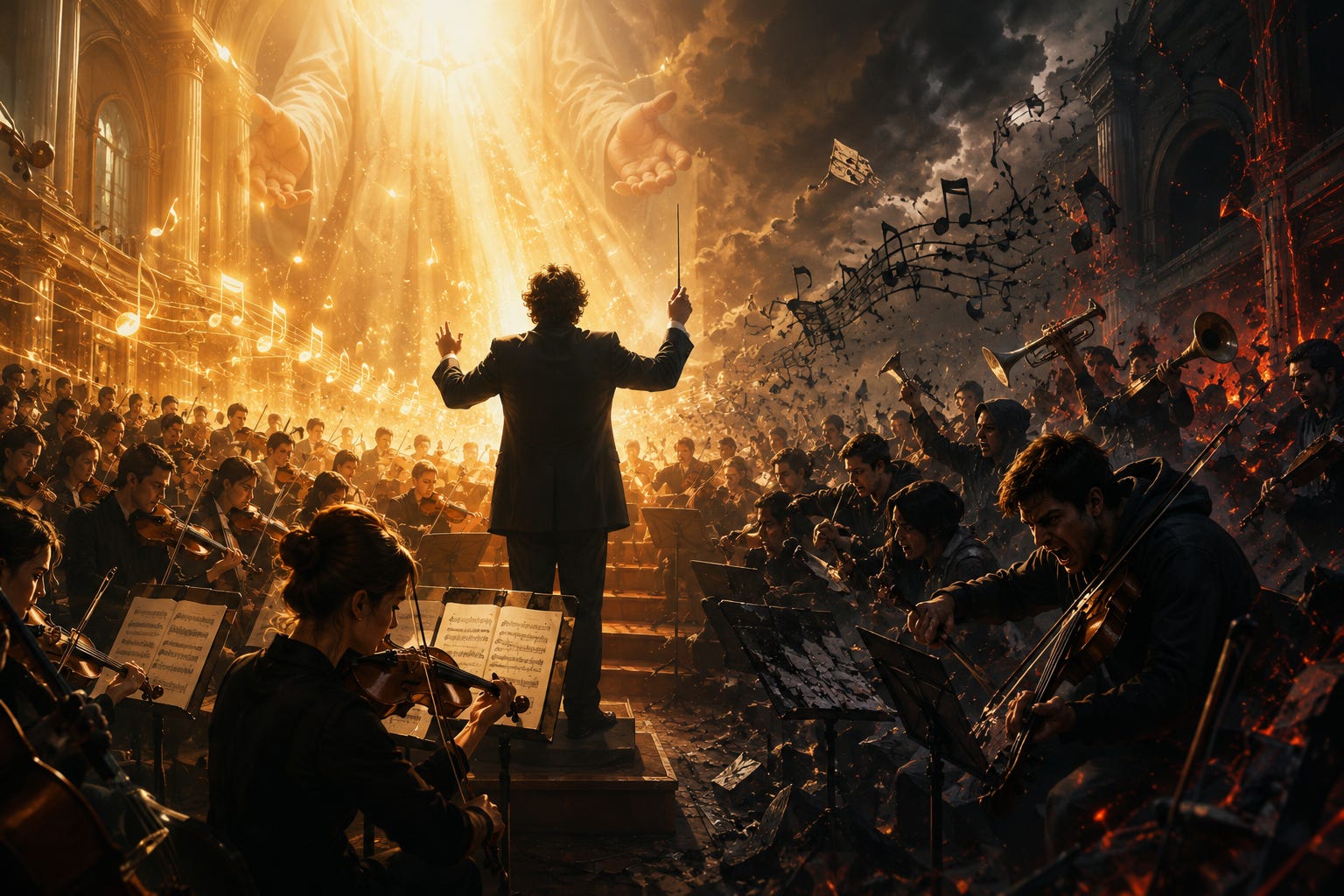
Imagine for a moment that the universe is something like a great symphony.
Many people speak of vibration, resonance, and frequency. While I do not find those ideas sufficient as a complete explanation of reality, they serve well enough as a metaphor.
Imagine that there exists a perfect melody.
Every note is flawless.
Every instrument is perfectly tuned.
Every harmony is complete.
Every color, every sound, every movement exists in perfect unity.
This, I suspect, is something like existence in the presence of God.
Now imagine that each of us has been given an instrument.
The Composer loves the song and desires to hear it played as it was always intended.
Those who love the song and long to hear it played well are patiently instructed. The Composer answers questions, teaches technique, corrects mistakes, and encourages practice.
He rewards effort, even while knowing that none of us will ever play perfectly.
We always fall short of the ideal.
Yet imagine that the Composer offers us a gift.
A perfect instrument.
An instrument incapable of producing a false note.
An instrument that perfectly expresses the music it was designed to create.
All we must do is accept the gift.
One day, those who desire the song more than their own pride will be invited into the great theater. Their worn practice instruments will be replaced. The music will finally be heard exactly as it was intended.
Perfect harmony.
Perfect beauty.
Perfect joy.
Those who reject the gift will receive what they have chosen instead. They will remain among the discordant noise they preferred. Not because the Composer delights in their absence, but because love does not compel participation.
The Composer is heartbroken by their choice.
But the choice remains theirs.
He desires musicians who truly want to play the song.
The song was always meant to be played perfectly.
And one day it will be.
My trauma, my hardships, and my struggles have all been part of learning my instrument.
The fact that I still long to hear the song is evidence that the Composer placed that longing within me from the very beginning.
He always intended the music to be played.
I am willing to endure the practice.
I am willing to endure the correction.
I am willing to endure the pain.
Because I trust the promise.
And when all is finally said and done, I will hear the symphony as it was always meant to be heard.
Not for a moment.
Not for a season.
But for eternity.
Beautiful analogy. Your instrument has touched the right notes.