
The Experts Will See You Now
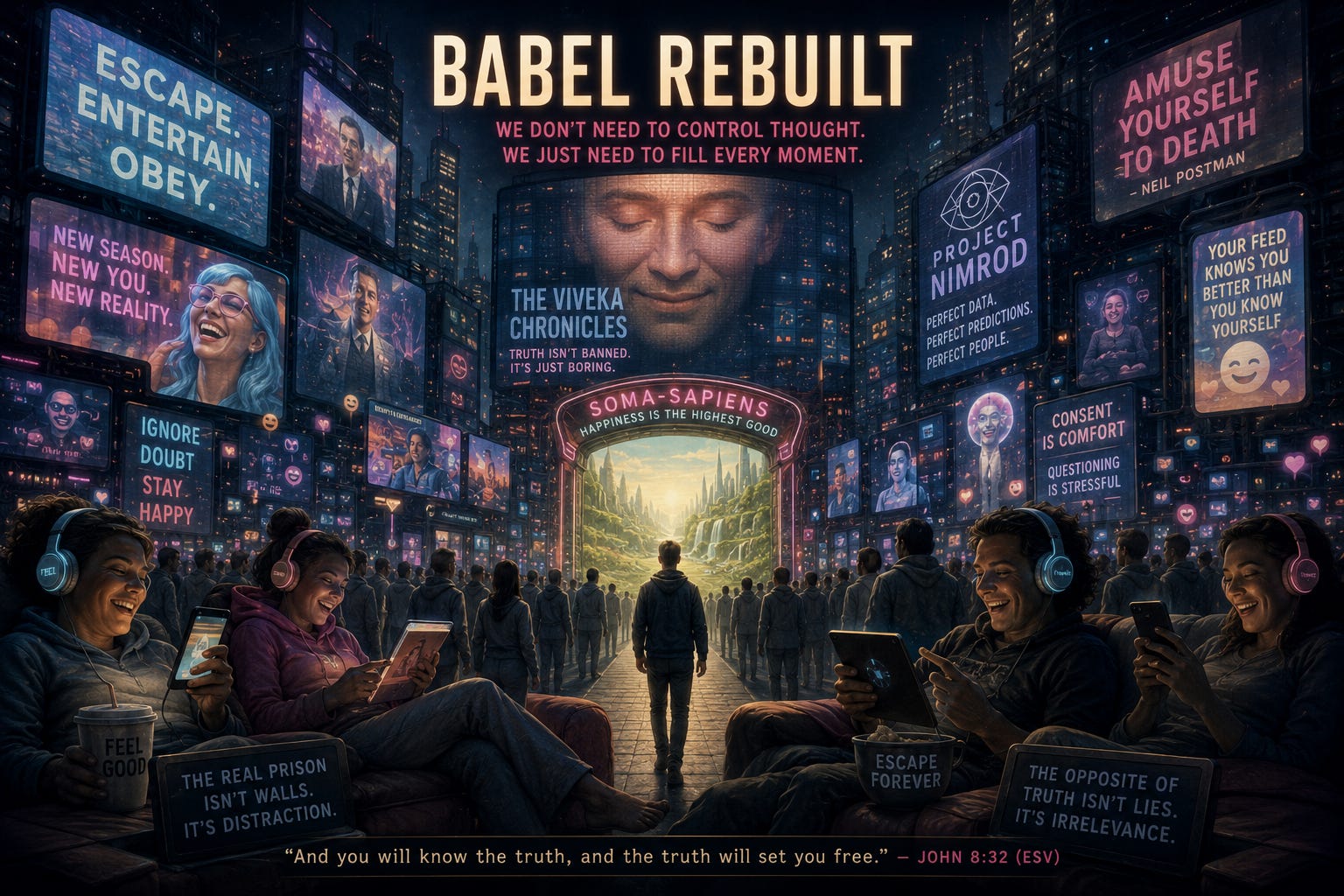
BABEL REBUILT

There has been much discussion as of late about the danger of misinformation.
We are warned daily about the perils of a misinformed and manipulated populace. Technology executives, media institutions, government agencies, and a revolving cast of politicians assure us that information must be carefully managed for the public good. The content available on their servers must be monitored. Opinions must be evaluated. Narratives must be curated. Truth, we are told, requires professional supervision.
After all, we cannot have people with differing opinions muddying the waters.
If an idea does not conform to the sanctioned doctrines of our reincarnated techno-gnostic priesthood, then it must be identified, corrected, labeled, suppressed, or removed entirely. Truth is evolving from its primordial form of moral relativity into something cleaner and more organized. It is becoming technocracy—the luxury sedan of secular humanist utopianism.
The circumstance we find ourselves in is sadly ironic.
Education in the United States has been disfigured in such a way as to leave its students increasingly bereft of the ability to reason. We have discarded logic, rhetoric, and intellectual curiosity in favor of memorization, credentialism, ideological conformity, and standardized metrics. The very institutions that lament the rise of misinformation often belong to the same educational framework that spent decades dismantling the tools necessary to identify it.
The ability to think critically and challenge assumptions stands in direct opposition to the ambitions of those who would prefer the public accept official narratives without question. A population trained to reason is difficult to manipulate. A population trained merely to repeat conclusions is considerably easier to manage.
Yet the decline did not begin with censorship.
It began with amusement.
Neil Postman observed that modern societies are unlikely to lose their freedom in the manner envisioned by Orwell. In Orwell’s world, books are banned. Information is restricted. Truth is suppressed by force. Postman feared something far more subtle. He feared a civilization that would voluntarily abandon the pursuit of truth because it had become addicted to distraction.
The distinction matters.
A population trained to think can resist propaganda.
A population trained to be entertained welcomes it.
Television transformed public discourse into spectacle. Politics became performance. News became entertainment. The internet accelerated the process exponentially. Today every claim competes for attention alongside celebrity gossip, viral outrage, advertisements, conspiracy theories, and an endless stream of digital novelty.
Truth increasingly finds itself judged by popularity rather than correspondence to reality.
The question is no longer, “Is it true?”
The question is, “Will it hold my attention?”
A society conditioned to consume information as entertainment gradually loses its ability to distinguish between what is important and what is merely interesting. Citizens become audiences. Audiences become consumers. Consumers become products.
At that point, censorship becomes almost unnecessary.
People willingly surrender their attention in exchange for distraction.
The technocrat inherits a population that has forgotten how to ask difficult questions.
The irony, however, is that the same mechanism used to create logical docility eventually becomes a liability. If I were to use algorithms to advance ideologies that resonate with a particular demographic, I could almost certainly find individuals at the periphery willing to accept even the most absurd claims as absolute truth. There are convincing videos supporting virtually any bizarre tangent imaginable. Every bias can find validation somewhere on the internet. Every assumption can locate an echo chamber.
The relativism preached in our classrooms has matured into its fullest expression in cyberspace.
There are seemingly infinite branches on the tree of knowledge, and there will always be another branch waiting to confirm what you already believe. You become both the butterfly and the collector, perpetually seeking validation while imagining yourself free.
I share concerns about the infinite marketplace of competing truths offered by the digital hive mind.
What I do not share is the desire to appoint a managerial class as the sole custodians of reality.
I do not trust self-appointed experts to determine which questions may be asked and which conclusions may be reached. Rather, I implore you to question what experts say and test it against reality. This does not mean attempting to replicate billion-dollar research projects in your garage. It means examining assumptions, identifying logical inconsistencies, evaluating evidence, and remaining willing to change your mind when warranted.
In short, it means thinking.
As a Christian, I am often accused of being biased because of my faith.
The accusation itself is revealing.
It assumes that religious commitments produce bias while secular commitments produce objectivity. Yet every human being reasons from assumptions. Every person possesses presuppositions. Every worldview contains foundational beliefs that cannot themselves be proven by the system they support.
The Christian simply acknowledges his.
Reason, in its most elemental form, is the process of comparing reality to an ideal. We observe the world around us and evaluate it according to standards we already possess. To pretend otherwise is merely to hide one’s assumptions beneath a veneer of neutrality.
The question has never been the case whether we possess standards.
The question is which standards do we trust?
G.K. Chesterton understood this well when he observed that when men cease believing in God, they do not believe in nothing. They become willing to believe almost anything.
When transcendent truth is abandoned, substitutes inevitably emerge.
Political ideologies become religions.
Experts become priests.
Institutions become churches.
Consensus becomes revelation.
The modern technocrat promises salvation through administration.
If only we centralize enough information.
If only we collect enough data.
If only we empower enough experts.
If only we eliminate enough dissent.
Then paradise can finally arrive.
But there is a problem.
Human beings are not raw material.
They are not machine components.
They are not data points.
They are not algorithms.
They are image bearers.
This is where Christianity diverges sharply from every utopian project in history.
Christianity does not teach that humanity can perfect the world.
It teaches that humanity cannot even perfect itself.
C.S. Lewis warned in The Abolition of Man that a civilization detached from objective truth would eventually produce what he called “men without chests”—individuals trained in calculation but lacking wisdom, virtue, and moral formation. Such people may possess tremendous technical knowledge while remaining incapable of answering the most important questions about human existence.
They know how.
They no longer know why.
Nikolai Berdyaev saw the same danger from another direction.
He warned that modern political systems increasingly sought to replace spiritual realities with earthly substitutes. The Kingdom of God would be exchanged for political programs. Redemption would be exchanged for social engineering. Salvation would be exchanged for administration.
The result is always the same.
The dream becomes a system.
The system becomes a bureaucracy.
The bureaucracy becomes coercion.
The utopia becomes a prison.
History is littered with the wreckage of paradise projects.
The twentieth century provided more than enough examples.
Yet the lesson remains largely unlearned.
The architects simply return to the drawing board.
More technology.
More management.
More surveillance.
More expertise.
More control.
The blueprint changes.
The ambition remains.
Babel rebuilt.
The Christian understanding of reality begins with a different premise.
The world is fallen.
Human beings are capable of remarkable good because they bear the image of God.
Human beings are capable of remarkable evil because they are fallen.
Any philosophy that ignores either truth eventually collapses into error.
This is why Christians should be deeply skeptical of utopian promises. Not because we oppose progress. Not because we reject science. Not because we fear technology.
Rather, because we understand that the fundamental problem of humanity is not technological.
It is spiritual.
No algorithm can solve sin.
No database can redeem a soul.
No expert committee can transform the human heart.
Aleksandr Solzhenitsyn famously observed that the line dividing good and evil runs not between classes, political parties, or nations, but through every human heart.
That truth is deeply inconvenient for those seeking heaven on earth.
It is easier to blame an opposing tribe than confront our own shortcomings.
Easier to centralize power than cultivate virtue.
Easier to censor dissent than pursue wisdom.
Easier to manage people than love them.
The answer to a world drowning in misinformation is not a smaller conception of truth administered by approved authorities.
The answer is a larger conception of truth.
A truth rooted in reality rather than consensus.
A truth capable of surviving scrutiny.
A truth that does not fear questions.
The technocrats dream of a perfectly managed world.
Christians should dream bigger.
Not because we expect heaven on earth.
But because we know heaven is larger than anything earth can offer.
As citizens of a kingdom not made by human hands, we should be careful not to mistake Babel for Jerusalem.
The builders of Babel sought to reach heaven through human ingenuity.
The modern world has merely upgraded the tools.
The tower now runs on silicon instead of stone.
The ambition, however, remains exactly the same.
“And you will know the truth, and the truth will set you free.”
— John 8:32
If you enjoyed this article, please consider supporting me by purchasing my book, Project NIMROD
Well said Aaron. Thanks for sharing...Ken man, DIGILEAK, Sooke, BC