
Single Point of Failure
ACCESS DENIED

Single Point of Failure
I woke up with a simple thought: my employer is going to expect me to sign up for a new digital ID just to access my benefits.
Before I even got out of bed, I reached for my phone to check the time—7:15. Later than usual. I caught myself flipping through the usual quick checks: weather, a glance at Substack. It’s a habit I don’t particularly like. I’ve tried to keep my phone in its place—useful, but not central. No notifications. Ringer on vibrate. Most of the time it stays downstairs on the table unless I need it.
And yet, there it is—already mediating the start of my day.
That’s the tension. Not just convenience, but dependence.
The stated goal of modern systems—the thing I’ve come to think of simply as the Machine—is efficiency. Everything is streamlined, optimized, frictionless. But there’s a tradeoff that rarely gets acknowledged:
The more efficient a system becomes, the more it tends to consolidate—and the more it consolidates, the more it risks becoming a single point of failure.
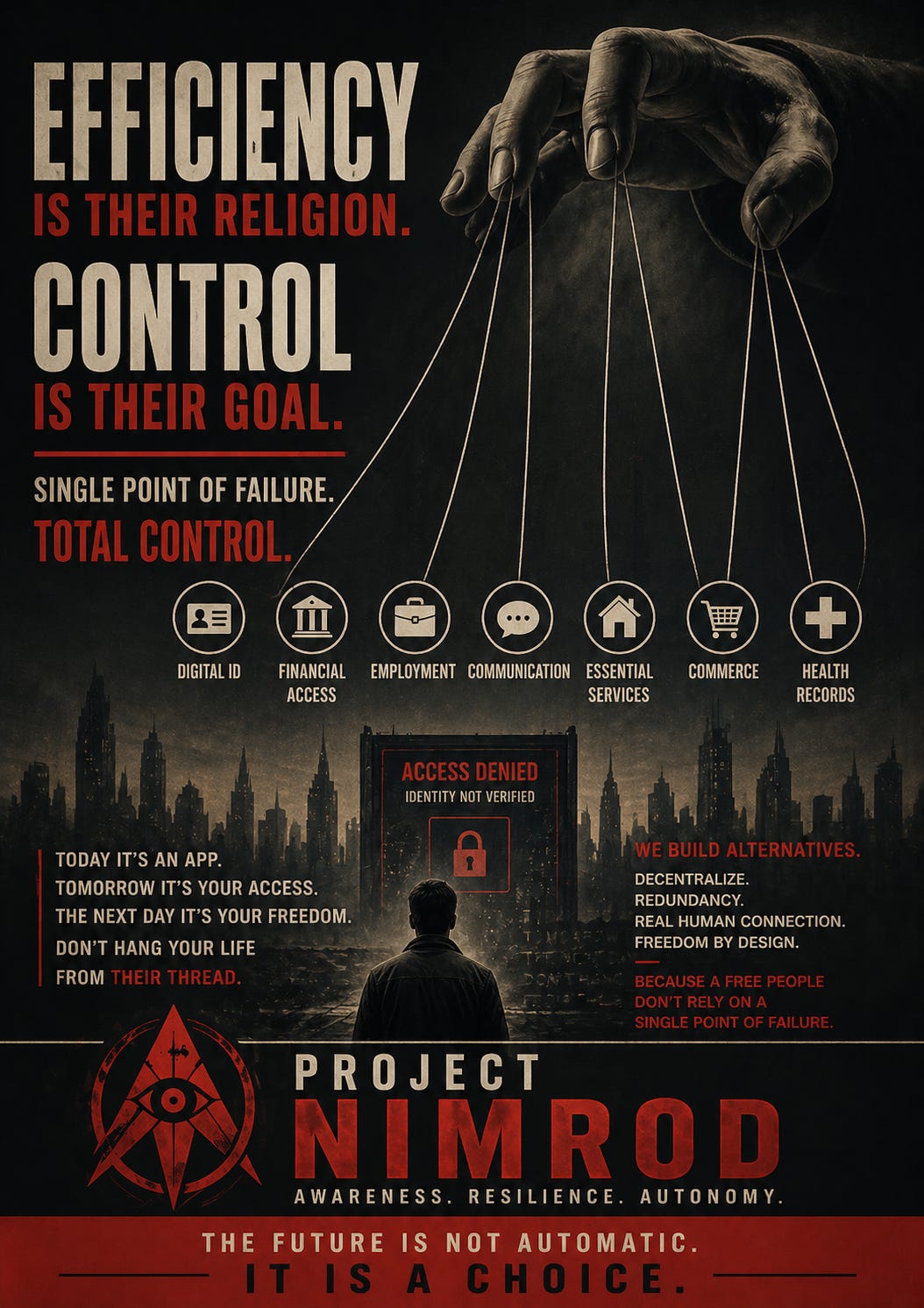
That’s not speculation. It’s a structural reality.
Redundancy, by definition, is inefficient. Backup systems, alternative paths, human workarounds—all of that slows things down. So over time, they get stripped away in the name of optimization. What you’re left with is something sleek, fast, and highly functional—right up until the moment it isn’t.
I see this play out constantly in small ways.
You try to set up a new printer, but the system can’t recognize your network, and the one button you need is greyed out. You want to save money with a digital coupon, but you’re required to log in through a platform you don’t even use. No account, no access. The system doesn’t bend—it just denies.
It’s always framed as convenience. But increasingly, it feels more like a gate.
Even basic human interactions are starting to route through these systems.
My nephew recently invited me to his baby shower. I texted him back: Of course, we’ll be there. Simple enough. But then I get a follow-up message telling me to click the link. The link pushes me to download an app. If I don’t want the app, I can use the browser—but that leads to a form asking for my full name, birthdate, gender, and who knows what else.
At that point, I stopped. Not out of spite, just principle. I already told him I’d be there. Why does showing up now require entering myself into a system?
I messaged him back, half joking: Not doing it. RESIST INTEGRATION.
It’s a small thing. But it’s not really about the baby shower.
It’s about the pattern.
More and more, access to ordinary life is being mediated by systems that require participation on their terms. Renting a truck, booking a place to stay, receiving an invitation, accessing benefits—there’s always another layer. Another login. Another verification. Another piece of yourself fed into the system.
We’re told it’s free. It never is.
This is an information economy, and data is the price of admission. Every interaction becomes a transaction, whether you notice it or not. What starts to emerge is something like a digital toll road—one where the cost isn’t always visible, but it’s always being collected.
The issue isn’t technology itself. I’m not interested in pretending we can or should roll any of this back. The issue is what happens when efficiency becomes the highest value, without any meaningful counterbalance.
Because efficiency doesn’t just streamline—it concentrates.
And concentration creates leverage.
If access to your finances, your employment, your communication, and your identity all run through the same interconnected systems, then it doesn’t take much to see the risk. A system failure, a policy shift, a bad flag on an account—suddenly, you’re not just inconvenienced. You’re cut off.
A single point of failure.
We instinctively understand the danger of that in other contexts. No one designs a building with one fire exit. No one rigs a climber to hang from a single thread. Redundancy exists because failure is not hypothetical—it’s inevitable.
But in the digital world, we’re moving in the opposite direction.
We’re consolidating.
Centralizing.
Integrating.
And each step makes the system more efficient—and more fragile.
I don’t think most people are consciously choosing this. It happens gradually, one small convenience at a time. One app. One account. One system that just works a little better than the alternative.
Until there is no alternative.
That’s the part worth paying attention to.
Not every new system is dangerous. Not every form of integration is malicious. But every time we hand over a little more autonomy in exchange for efficiency, we should at least recognize the trade.
Because when everything runs through the same channel, it only takes a single break—or a single decision—to shut it off.
And I don’t know about you, but I have no interest in living my life hanging from a thread that someone else controls.
Spot on Aaron. I have been feeling that singularity pull from the Technate Agenda for a long time.
Nice examples. Other examples are the elimination of the use of cheques, money orders and cash, in lieu of Charge Card Monopolies that track and trace you. Something government, banks and Big business are all on board with. Much appreciated. Kman, editor, DIGILEAK News Not Noise (Bitchute)