
Mundus Vult Decipi
The World Wants to Be Deceived

There is an old Latin phrase:
Mundus vult decipi.
“The world wants to be deceived.”
The fuller version is even harsher:
Mundus vult decipi, ergo decipiatur.
“The world wants to be deceived, therefore let it be deceived.”
At first glance, it sounds cynical. Bitter, even. The sort of phrase muttered by disillusioned men who have mistaken disappointment for wisdom. It is easy to hear it as arrogance. The implication seems obvious: everyone is stupid except me.
But that is not the most dangerous interpretation of the phrase.
The dangerous interpretation is that it may contain more truth than we would like to admit.
Not because people are unintelligent. Human beings are extraordinarily intelligent. Intelligent enough to split the atom, manipulate genomes, build machine learning systems, and map the stars. The problem is not that man is incapable of reason.
The problem is that reason is often subordinate to desire.
We do not merely seek truth. We seek comfort. We seek belonging. We seek psychological safety. We seek narratives that protect us from uncertainty and responsibility. And once those desires become primary, truth becomes negotiable.
That is the real significance of mundus vult decipi.
It is not merely that people can be deceived.
It is that many people will participate willingly in their own deception if the illusion offers them something they value more than truth.
The Lie We Call Neutrality
Modern society prides itself on rationality. We imagine ourselves uniquely enlightened compared to the primitive superstitions of earlier civilizations. Ancient people bowed before idols of wood and stone, while we follow “science,” “data,” and “the experts.”
Yet this confidence itself may be one of the greatest illusions of all.
Human beings have not ceased being religious creatures. We have simply changed the objects of worship.
The ancient world worshipped kings, temples, and tribal gods. The modern world worships systems. Institutions. Algorithms. Consensus. Branding. Ideology. Technology. Progress.
And perhaps most of all, we worship the comforting fantasy that we are objective.
The irony is difficult to miss. We live in an era obsessed with misinformation while simultaneously existing inside the largest and most sophisticated propaganda infrastructure in human history.
Advertising alone consumes trillions of dollars because corporations understand something fundamental about human beings: facts rarely move people. Emotion does. Identity does. Desire does.
Most persuasion has very little to do with logic.
A man does not buy a product because he rationally analyzed its utility. He buys it because it promises status, beauty, belonging, youth, masculinity, security, or meaning. Political movements operate the same way. So do religious movements. So do social movements.
Propaganda succeeds because it tells people what they already wish to hear.
That is why simplistic explanations spread so easily. They relieve us of the burden of complexity. They transform reality into a morality play populated entirely by heroes and villains. They give us enemies to hate and tribes to belong to.
And perhaps most importantly, they absolve us of responsibility.
The Seduction of Certainty
There is a reason totalitarian systems always promise certainty.
Certainty is intoxicating.
The world is confusing. Human beings are contradictory. Reality is messy. Moral decisions are often painful and ambiguous. Genuine wisdom requires humility because honest people eventually encounter truths they cannot fully reconcile.
But certainty eliminates tension.
The ideologue never has to wrestle with complexity because every question already has an approved answer. Every problem has an approved enemy. Every moral dilemma has already been simplified into slogans.
This is why propaganda rarely begins with obvious lies. It begins with partial truths attached to emotional dependency.
A system does not need you to believe everything immediately. It merely needs you emotionally invested enough that questioning becomes psychologically painful.
Once identity fuses with ideology, evidence becomes secondary.
And this phenomenon is not isolated to governments or political extremists. It infects nearly every domain of human life.
Religious institutions do it.
Corporations do it.
Political parties do it.
Media organizations do it.
Even countercultural movements eventually do it.
Because the temptation toward ideological possession is not merely institutional. It is deeply human.
The desire to escape uncertainty is universal.
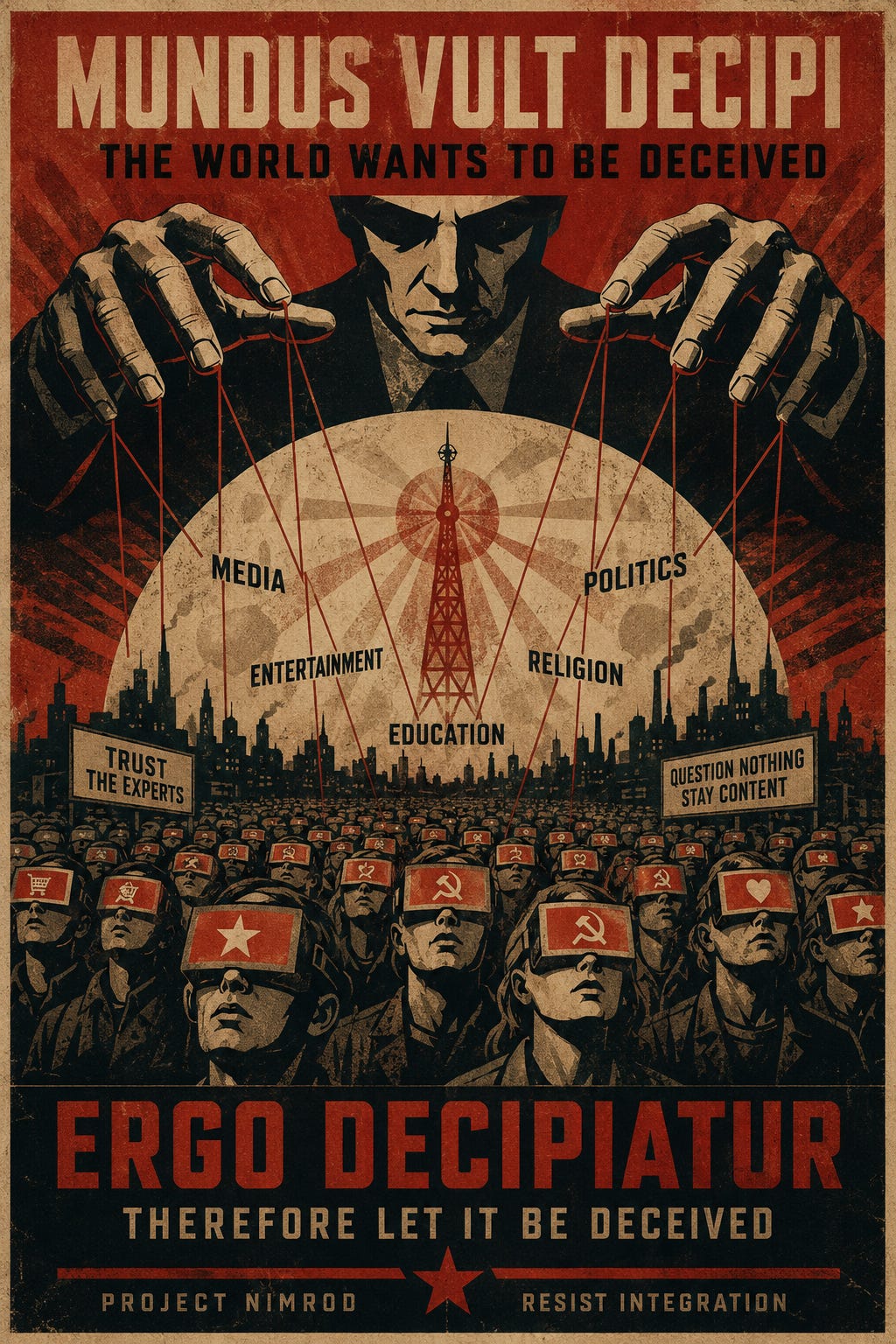
Technology and the Industrialization of Illusion
Jacques Ellul understood this better than most.
He argued that propaganda was not simply a political tool, but an inevitable feature of technological society itself. A mass society governed by complexity requires mechanisms of psychological integration. Human beings must be conditioned to function inside systems too large and abstract for individuals to meaningfully comprehend.
That observation feels disturbingly relevant now.
Modern propaganda no longer arrives primarily through overt state messaging. It arrives through algorithmic reinforcement. Through curated feeds. Through outrage cycles. Through social incentives. Through entertainment. Through the endless shaping pressures of digital life.
The modern individual exists inside a continuous stream of psychological manipulation so pervasive that it becomes invisible.
And the truly unsettling part is this:
Most people do not want it to stop.
Because endless stimulation protects us from silence.
And silence is dangerous.
Silence forces reflection.
Silence forces confrontation with conscience.
Silence forces us to encounter the uncomfortable possibility that many of our beliefs are inherited, performative, tribal, or self-serving.
It is easier to scroll.
Easier to consume.
Easier to repeat approved slogans than to think deeply enough to risk social isolation.
The technological world does not merely deceive us. It conditions us to prefer deception because deception is easier to metabolize than truth.
Truth often demands sacrifice.
What the Christian Risks
Christianity introduces a complication that neither cynicism nor naïve optimism can resolve.
Scripture affirms that human beings are fallen. Self-deception is part of our nature. Pride distorts perception. Desire corrupts judgment. We are not neutral creatures objectively examining reality from nowhere.
But Christianity also refuses to reduce human beings to machines or animals.
Man is fallen, but not meaningless.
Corruptible, but not irredeemable.
This distinction matters because there are two equal and opposite errors people tend to fall into after recognizing deception.
The first is naïveté.
The second is nihilistic cynicism.
Naïveté assumes most systems are fundamentally trustworthy if properly managed. Cynicism assumes truth itself is unattainable and all claims merely disguise power struggles.
Both collapse eventually.
The Christian worldview rejects both because it insists that truth exists while simultaneously acknowledging humanity’s profound capacity to distort it.
That means discernment requires humility.
The man who recognizes propaganda but becomes consumed by arrogance has merely exchanged one deception for another. Conspiracy thinking often falls into this trap. The individual becomes addicted to the emotional gratification of feeling uniquely enlightened.
But genuine wisdom produces sobriety, not grandiosity.
The more honestly a person examines reality, the more cautious he becomes about his own susceptibility to manipulation.
Because the line between truth-seeker and ideologue is thinner than most people realize.
Pride and a desire to be seen as enlightened can manifest as self-righteousness and alienating. The opposite of what Christ taught.
Why People Choose Illusion
The hardest truth embedded inside mundus vult decipi is that deception often serves emotional needs.
People cling to illusions because illusions protect them from suffering.
Some lies protect status.
Some protect identity.
Some protect comfort.
Some protect despair.
A man may reject truth because accepting it would require forgiveness. Another may reject truth because it would require repentance. Another because it would require courage.
Truth is dangerous because truth demands transformation.
And transformation is painful.
This is why Christ so often offended religious and political authorities alike. Not merely because He challenged institutions, but because He challenged self-justification itself.
The human ego desperately wants innocence without repentance. Redemption without sacrifice. Meaning without submission.
We want salvation while remaining sovereign over ourselves.
In that sense, the oldest deception is not technological at all.
It is spiritual.
Resisting Integration
The central struggle of modernity may not be merely political or technological. It may be anthropological.
What does it mean to remain human inside systems increasingly designed to standardize, predict, influence, and integrate human behavior?
That question sits underneath much of our cultural anxiety whether we recognize it or not.
The problem is not technology itself. Technology is a tool. The deeper issue is whether human beings possess enough moral and spiritual grounding to resist becoming psychologically absorbed into systems optimized for control, comfort, and efficiency.
A society can become highly advanced while simultaneously becoming spiritually hollow.
In fact, history suggests the two often develop together.
Perhaps that is why mundus vult decipi still resonates centuries later.
Because it confronts us with an uncomfortable possibility:
The greatest threat to truth may not simply be tyrants, propagandists, or corrupt institutions.
It may be the part of ourselves that quietly prefers illusion.
And if that is true, then resistance begins not merely with exposing lies “out there,” but with confronting the lies we ourselves are most tempted to believe.
That is a far more difficult task.
And probably a far more important one.
Excellent post; I am a sucker for any Jacques Ellul reference.