
Men With Chests
BETTER MAN REVISITED

I was listening to the No Agenda podcast the other day while I was working around the house. I’ll often put something on as I’m doing my chores; audiobooks, podcasts, the occasional music. As I was completing the simple tasks that help me feel like I’m contributing to the household, I heard something that really threw me for a loop. It’s one of those things that can come across as entirely innocuous to most, but for me, it was upsetting.
A clip of UK Prime Minister, Keir Starmer played. “All I ever wanted for my children was for them to be happy and safe.”
I shuddered at this, thinking how completely out of touch with fatherhood this man must be. I tried to hold back judgement, because that’s my responsibility, but it was difficult.
Years of studying propaganda, psychological operations, and neurolinguistic programming make me very suspicious of any person in a position of power when they speak publicly. They have a team of writers generally, so I am not ever sure how much of a reflection anything politicians say is of their own personal beliefs.
But back to my reaction to Starmer’s statement. I know it sounds like something a dad might say about his kids. Perhaps one that wasn’t thinking clearly might make this simpleton’s mistake. But to say something so devastatingly naïve about your children is either an intentional piece of Huxleyan propaganda, or ignorance.
“All I ever wanted for my children is for them to happy and safe.”
I am so grateful that my father didn’t have this philosophy. I didn’t employ it for my own children either. Do I want my children to experience moments of happiness?
Of course.
Do I want my children to be safe?
You bet.
That’s not even close to what I really want for my children though. I want them to be resilient. I want them to be compassionate. I want them to serve God and know that there is more to life than being safe. In fact, the most important thing about life is not the cozy, warm shelter of safety.
The most important things are always the hardest ones.
So, yes, I also want my children to experience hardship. I want them to know what it feels like to struggle and toil. I want them to know loss and face challenges that push them to their limits.
I don’t want them to suffer. I don’t relish the pain that comes with hardship, but Lord knows I want them to learn that they have the strength and resilience to overcome adversity. I want them to grow and build things. I want them to endure.
Winston Churchill famously said: “Success is not final, failure is not fatal: It is the courage to continue that counts.”
James 1:2-4 and 12 hold some of my favorite passages.
2 Count it all joy, my brothers, when you meet trials of various kinds, 3 for you know that the testing of your faith produces steadfastness. 4 And let steadfastness have its full effect, that you may be perfect and complete, lacking in nothing.
12 Blessed is the man who remains steadfast under trial, for when he has stood the test he will receive the crown of life, which God has promised to those who love him.
There are many other scriptures that comment on the importance of our ability to remain steadfast in the face of adversity. 2 Corinthians 12:9-10 says:
9 But he said to me, “My grace is sufficient for you, for my power is made perfect in weakness.” Therefore I will boast all the more gladly of my weaknesses, so that the power of Christ may rest upon me. 10 For the sake of Christ, then, I am content with weaknesses, insults, hardships, persecutions, and calamities. For when I am weak, then I am strong.
Again, perhaps Mr. Starmer has a very superficial idea about fatherhood. I hesitantly suspect though, that this statement is more related to the dominant narrative that I’ve noticed being pummeled into the hearts and minds of the population:
As long as you’re happy and safe, you have all that you need. This smacks of “You will own nothing and be happy” to me.
I am so grateful that my father chose to spend his life developing me into someone who knows how to lean on the Lord for my strength, and to revel in the challenges set before me.
I can be safe and happy on my couch with a good movie and a full stomach. I can be safe and happy when I am indulging in my most banal existence.
What I don’t feel in those moments is joy, triumph, or accomplishment.
I have added this rather long caveat to a rewrite of an article I released last year in honor of the man that raised me. I hope you enjoy it. Every one of you out there who are dedicated fathers are doing something amazing, and sadly less and less common.
You’re leading by example and helping your children not only remain safe and experience moments of happiness, but you’re preparing your children for a life that is often unforgiving and harsh. You’re providing your children with the tools necessary to meet whatever challenge arises with dignity and honor. God bless each one of you. Keep fighting the Good Fight.
Better Man Revisited:
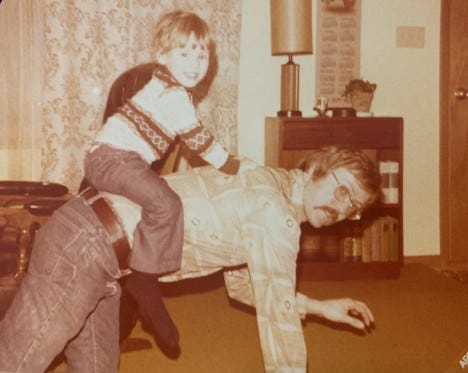
Every single day that we walk on this green earth is a miracle. The countless generations that have come before us all fought and toiled to ensure the survival of the next. Sometimes I think about the immensity of that, and it makes me feel quite insignificant.
Can you imagine the kind of grit and determination it took to grind out an existence in a place like Wisconsin, before all the modern conveniences we enjoy? We can read about it, and we can create films and write books about it, but the day-to-day life of our ancestors is relatively a mystery to us from an experiential perspective.
This is all coming from a man who is blessed beyond reason. I never go hungry because I have to. I never suffer extreme weather unprotected unless I choose to. I live a modest life with a small home and an average income that allows me to pay my bills on time with a little left for savings. Relative to my earlier days, I’m a success story. Relative to many of the people in the world, including my ancestors, I live like a king. It is all about perspective.
Today we are told it is time to recognize the fathers of our country. It is a clever way to sell greeting cards. Despite my general distaste for commodifying emotions, I decided to set aside my feelings and write a short piece to honor the fathers. My own, in particular.
My dad is the son of a Scottish immigrant who never really had time to be a dad. I know very little about him, but he died when my dad was only fifteen years old. My father was never really shown how to be a dad and had to figure things out on his own. I chose to write this, not only to honor him, but to push back against the Homer Simpson, Al Bundy, and Peter Griffin stereotypes that we are constantly bombarded with. Men are made to look like stupid, knuckle-dragging clowns, and have been for some time now. The attack on masculinity is prevalent and insidious. I wanted to give an example of a man who shatters that shallow and stupid veneer we have been so carelessly subjected to.
My dad worked a lot of jobs when I was younger. He did whatever it took to put food on the table and never complained to us about it. He was frugal and disciplined, honest and caring, and tough as a coffin nail. I can say that without an ounce of embellishment. He also dropped out of high school to work full-time and help support my grandmother after his own father died. My dad had been a freshwater surfer in Sheboygan where I grew up, a member of a motorcycle club, and no stranger to a barstool when I was a wee lad.
I was born in 1976. The economy was not doing well, and we barely scraped by as I was growing up. When I was about five or six years old, he was in the kitchen one night, reading the Bible. He surrendered his life to Christ and all of our lives changed after that.
Before long he was no longer smoking and drinking. He was present, as often as work allowed him to be, and genuinely engaged in our lives. When the foundry he worked for laid him off, again, he went to a local plastics factory and applied for a job. They told him they would call him back and he just responded, “It’s okay. I can wait” and wait he did.
For hours he sat there in a chair, knowing that his family needed him to come through for them and he waited. He was asked to leave and politely declined. Eventually, the manager must have become curious about the stubborn man in the reception area and agreed to speak to him. He made his case and was offered a position.
He spent the rest of his working life at that factory and the high school dropout retired as the head of technical development, running teams of engineers and designing manufacturing equipment. I could go on for hours about all the ways he inspired me and educated me.
It would be foolish of me to say that my dad never made mistakes. He made tons of them and owned every one of them. He never really had an example of what a dad should look like from his own father. He did have a heavenly father to whom he looked. He fought every day to be the man he needed to be for his family. He still does to this day.
There are real men who are fighting every day to give their families a better life than they had. Our culture wants you to believe that guys like my dad are chest-thumping idiots. They want you to believe that being a man means you like boobs and drink beer. They want you to believe that it is okay to have baby mamas and not pay child support. There are plenty of men who have adopted the negative attributes ascribed to them by culture.
I wanted to write this to encourage those of you who are out there, fighting the Good Fight and doing whatever it takes to put food on the table and to be an example of what right looks like to your children. You are not alone. Don’t accept the stereotypes you are labeled with. Be proud but not arrogant, be strong but not oppressive, be humble when you are wrong and steadfast in your role as a leader.
Weak-kneed men have shied away from the idea of being the head of the family. C.S. Lewis called these “men without chests”. They misunderstand what that means because they have listened to the nonsense that modern culture has fed them. We are to love our wives like Christ loved the church. Being the head of the household doesn’t mean being an iron-fisted ruler. After all, Christ sacrificed his life for the church.
Real leadership is sacrifice. Being the one to make the final call doesn’t mean not acknowledging the wisdom and capability of our wives. It means being willing to be the one who takes the fall when things go sideways and being a windbreaker against the storms of life for your family. There are more of us out there than you know. The media has the spotlight, but the real dads take the hits and keep on getting up.
Thank you, dad, for being the guy who hits the canvas and gets back up, every time. Thank you for showing me what right looks like. I may have made a mess of things time and again, but the seeds you planted have not been lost. Thank you to the rest of the dads out there who are willing to place your children’s welfare above your own desires.
Fatherhood can be a thankless and long-suffering job, but it’s never over. Even if you have fallen down in the past, you can get back up and do the right thing. Some may think it’s too late. Some may believe they wasted their chances. I have watched fathers die without making amends to their children, and children too hurt to forgive their dads for previous failures. It is a painful and tragic thing to behold, and it benefits no one.
I know there are a lot of people out there without fathers in their lives. They may have passed away, left them, or just never been around. I also want you to know that you are not alone. We all have a heavenly Father who loves us and will be there for us. Like my dad did so many years ago, you can call upon Him, and He will guide you.
Train up a child in the way he should go—but be sure you go that way yourself.
—Charles H. Spurgeon, British Baptist pastor
My dad was killed as an unwilling participant in Vietnam when I was one, so I have never known what it’s like to have a complete family with a dad, but I can try to imagine it.
This gives real honor to your dad, sprinkled with lots of good advice. Nice picture too. :)
Appropriate for Father’s Day. When married couples raise children, will they want them to be safe and happy? Or will they want them to grow despite hardship?