
Letters and Spirits
BRIDGING THE GAP

There is a constant tension within humanity that reveals a natural bifurcation among people. This does not imply there are only two kinds of people in the world. Rather, among those inclined toward moral concern and ethical living, there are two distinct tendencies that emerge repeatedly in daily life. There is certainly a segment of the population for whom morality is ambiguous at best and absent at worst. For those disinclined to concern themselves with what they ought to do, much of this discussion will be less applicable. God save them.
The first group consists of what I commonly refer to as “rule followers.” These are the people for whom clearly defined boundaries provide a sense of safety and security. They tend to be more risk-averse and rigid in their thinking. Predictability and consistency are cherished almost above all else. In their eyes, preserving tradition is the axiomatic path to virtue and right living. Life is most comfortable when approached through systems and objectivity. Their lives are framework-dependent.
There is much to be said for the value of tradition and predictability. Rules provide a framework that allows people to approach life with a level of certainty that alleviates anxiety and offers a clearer path toward what ought to be done. Current cultural trends in the West have become increasingly hostile toward tradition. Marxist and postmodern ideologies have worked tirelessly to dismantle the past so that the tyrants of the present may reshape the world in their own image. I see the deleterious effects of this daily.
The abuse of our ancestors and the relentless demand for change—always more change—unmoor people from the past and leave them vulnerable to whatever half-baked schemes idealists and reformers happen to champion at a given moment. The propaganda and psychological operations employed to destroy historical continuity are evident throughout mass media. To me, this is self-evident. Some insist this is merely a necessary stage of human evolution. They claim humanity is perpetually progressing.
I believe this reflects a profound misunderstanding rooted in the assumption that technological advancement is the defining characteristic of an evolved society. That perspective also depends upon a certain hubris regarding our present state as a species. Slavery remains rampant across the globe. Mass surveillance and the suppression of dissent are widely tolerated. Even our inability to coherently define what “progress” truly means makes this hypothesis deeply tenuous at best.
Words matter.
Tradition matters.
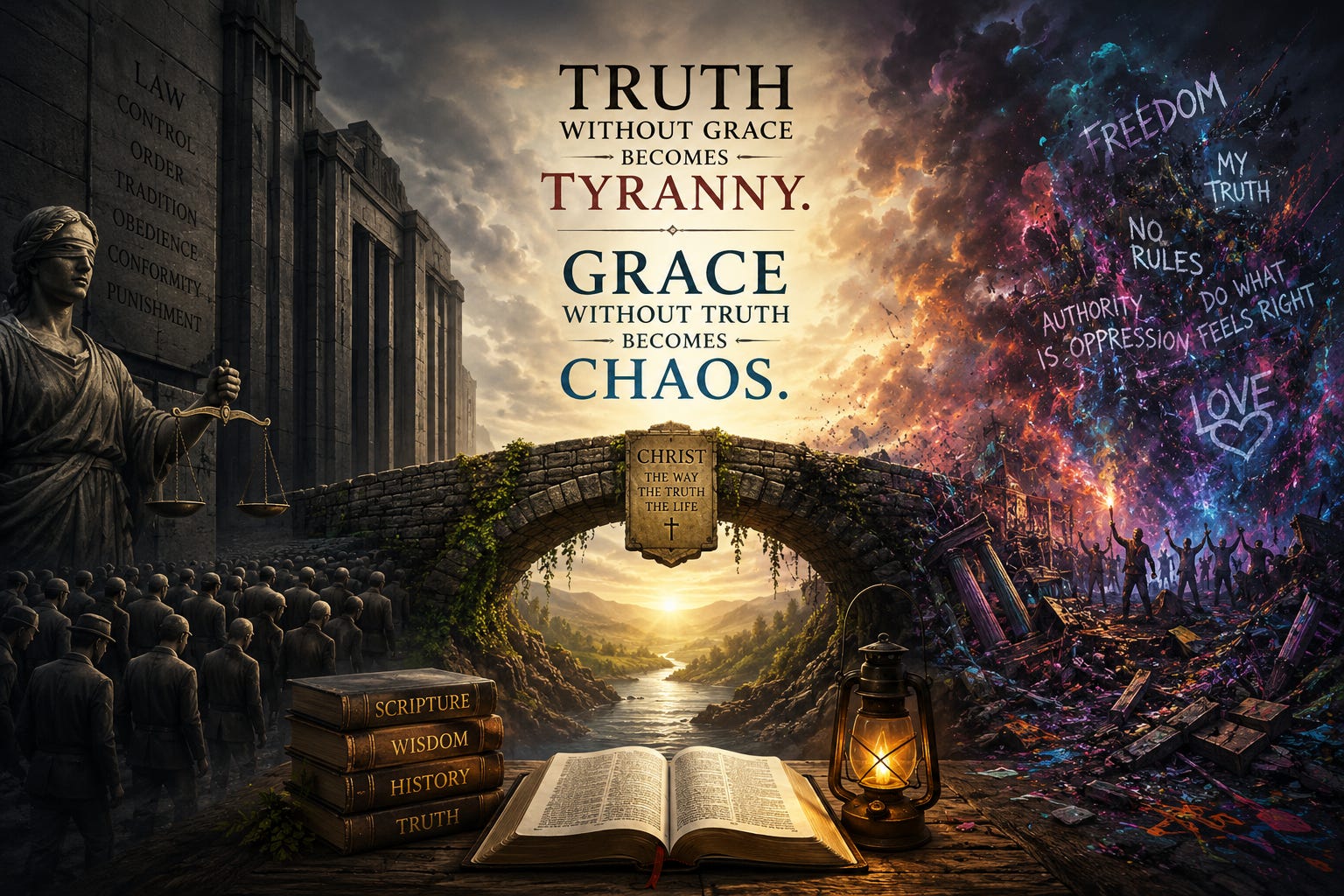
God has provided humanity with a clear moral framework and expectation for how we ought to live. The secular world has largely tossed faith and tradition into the wastebasket, dismissing the idea of transcendent truth altogether. This malleable morality is extremely useful if one prefers to become the lawmaker of his own universe.
The morally relativistic landscape of modern culture has devastated the West at an alarming rate. I do not judge those who cling tightly to tradition. In many ways, their devotion and consistency should be admired. Without a segment of the population willing to preserve the dignity of their ancestors and traditions, society collapses into rootlessness and confusion. Any honest assessment of our present condition should at least allow room for that possibility.
This provides, in abbreviated form, an argument for the conservative disposition toward life. I use the word conservative here in its purest sense, detached from party politics. Politics is not the focus of this article.
At the same time, I believe it is prudent to address the dangers of the conservative mind as well.
Jesus openly challenged rigid legalism when He warned about putting new wine into old wineskins. The New Covenant was not a refutation of the Law, but its fulfillment. Throughout the Gospels, Christ repeatedly rejected the rigid and lifeless application of religious law that characterized many of the Pharisees.
He declared Himself “Lord of the Sabbath” and reminded His listeners that “the Sabbath was made for man, not man for the Sabbath.” This distinction matters immensely. It speaks directly to the difference between following the letter of the law and understanding the spirit of the law.
How, then, does one thread this needle?
It is a question I ask myself often and pray about regularly.
The opposite tendency consists of those who focus more heavily on the spirit of the law. As I said earlier, this is undeniably present in the teachings of Christ. Yet the pendulum has a habit of swinging too far whenever human beings are involved. Course correction is rarely clean.
To illustrate the contrast, I will place the “Letter of the Law” beside the “Spirit of the Law.” These are merely observations I have made. I do not claim authority here. I am simply attempting to think clearly.
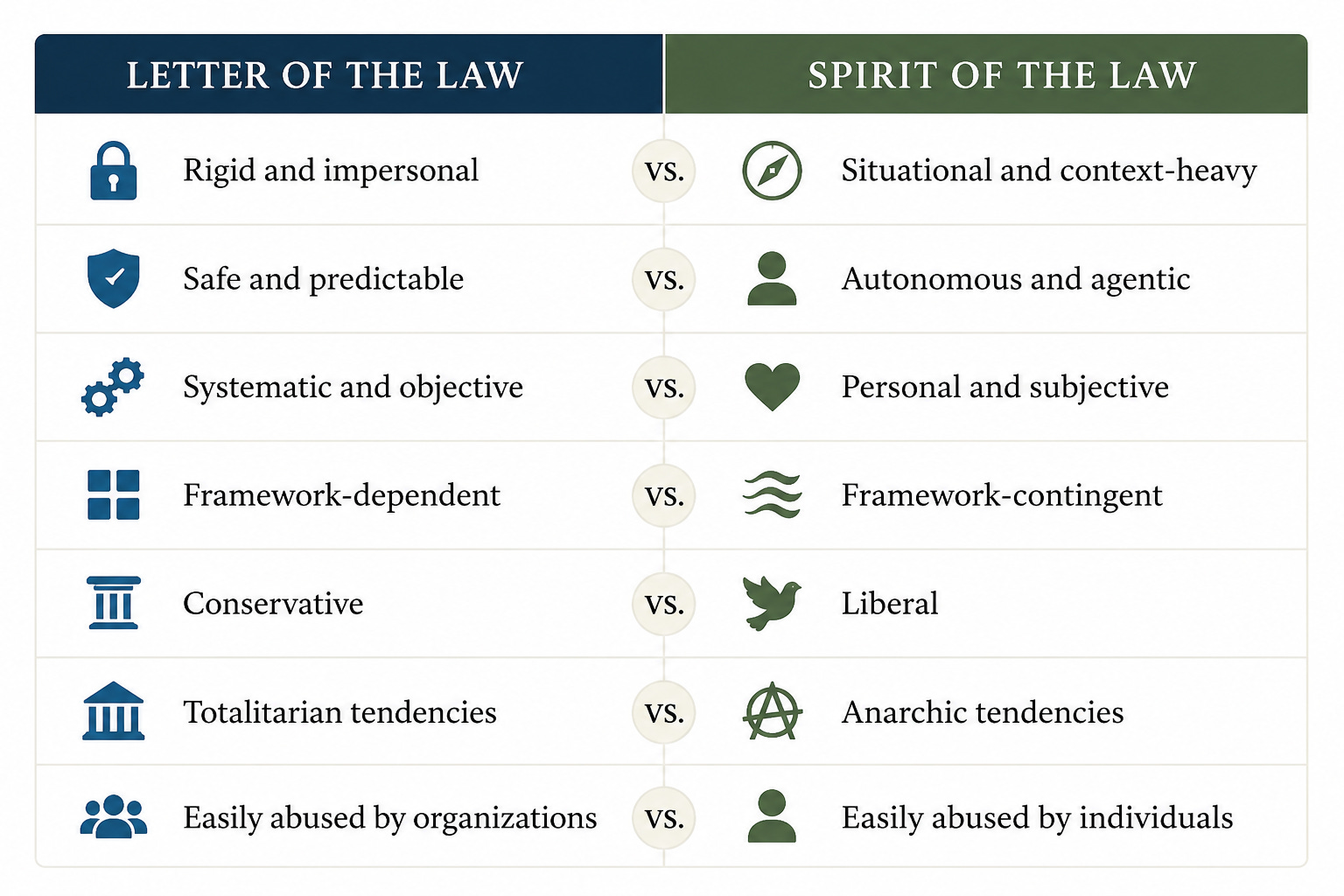
These lists are neither exhaustive nor necessarily complete. Again, they are simply observations. My point is not to condemn either tendency outright, but to note that both possess strengths and dangers.
As with most things, balance seems necessary.
The Law was divinely inspired and given to Israel. It was expected to be followed completely. Yet God also knew that humanity would fail. Free will all but guaranteed that outcome. We were never capable of perfection while retaining the capacity to choose sin.
Sin.
That is a word guaranteed to ruffle feathers.
Moral relativists—and even many who claim to believe in transcendent truth—often recoil at the suggestion that there exists a perfect and holy Lawgiver to whom all people are accountable. The doctrines of sin and salvation are not for the faint of heart.
Even so, most people still recognize that right and wrong exist. Truly pathological individuals who cannot distinguish between them are comparatively rare. As stated earlier, this discussion is not really aimed at them.
G.K. Chesterton made this point masterfully in Orthodoxy:
“If it be true (as it certainly is) that a man can feel exquisite happiness in skinning a cat, then the religious philosopher can only draw one of two deductions. He must either deny the existence of God, as all atheists do; or he must deny the present union between God and man, as all Christians do. The new theologians seem to think it a highly rationalistic solution to deny the cat.”
Moral relativism is ultimately indefensible in my view.
People often say things like, “This is my truth.”
Truth does not become conditional simply because we attach a possessive pronoun to it. Adding a descriptor before the word “truth” does not alter reality. In many cases, it merely creates a contradiction in terms. It is logically incoherent—much like the modern obsession with perpetual change for its own sake.
Denying the cat is not a defensible position.
For anyone inclined to object to my claim that many people are “denying cats,” I would encourage them to spend time in a psychiatric treatment facility. Nowhere is this conflict between objective truth and institutionalized subjectivity more visible than in modern approaches to mental health and social normalization.
The experience can be illuminating and deeply unsettling. The scale of contradictory messaging encountered there is difficult to overstate.
As someone who works in this field, I can tell you plainly that, in some cases, the lunatics are truly running the asylum.
That is not to say there is no value in the assessment or treatment of mental illness. Rather, it is to question some of the assumptions surrounding how we define and classify it in the first place. It is a slippery slope if ever there was one.
For those interested in exploring this idea further, I would recommend the work of Thomas Szasz, particularly his book The Myth of Mental Illness, which forcefully challenges many prevailing assumptions surrounding psychiatry and social control.
Ultimately, this article is simply a thought experiment that I wanted to share.
My purpose is not to condemn people or pretend that I possess all the answers. Rather, I think it demonstrates how easily human beings speak past one another. In many cases, people disagree less about morality itself than they do about definitions, assumptions, and temperament.
Perhaps this perspective may help some readers see their friends and family members differently.
I understand that many people will immediately reject my biblical worldview. I am accustomed to that. It is not a hurdle I expect to overcome through argument alone. I am admittedly inflexible in my faith.
Do I have doubts? Of course. Everyone does—or should at some point.
But I remain unwilling to abandon my hope in Jesus Christ.
I hope you share that hope. I pray you find it if you do not.
That choice is not rooted in sentimental escapism or “hopium,” as critics often suggest. It is grounded in a lifetime spent learning, questioning, suffering, observing, and seeking.
In the end, the only hill truly worth dying on is Calvary.
I thank God that was done for me—and for you.
Truth without grace becomes tyranny.
Grace without truth becomes chaos.
I am wondering that the decades of movie industry horror movies and gaming industry killing games have desensitized the younger generations to the point of losing a sense of empathy and a capacity for morality and justice. Comments?