
Do We Want to Die?
HOW A CULTURE OF FEAR MISTAKES AWARENESS FOR ACTION

Do we want to die?
When I was in my teens and twenties, I was extremely depressed. I often put myself in situations where I was likely to be harmed. I never thought of myself as overtly suicidal, but when I look back at what I was doing and the situations I intentionally placed myself in, it becomes clear that I was what might be called latently suicidal. In other words, I wanted to die, but I did not want to think about it.
In his book A Confession, Leo Tolstoy describes his own battle with despair. Despite fame, success, wealth, and recognition, he found himself staring into an existential abyss. He had achieved everything his culture told him should produce happiness, yet he found himself contemplating death. I suspect many people today find themselves confronting a similar emptiness, though we rarely discuss it openly.
Perhaps the better question is not whether we want to die physically. Most people do not. The more troubling question is whether we have quietly lost the will to live fully.
We are living through a crisis of meaning. The decadence, moral relativity, apathy, and self-imposed ignorance that characterize much of modern society have reached a point where they can no longer be dismissed as isolated problems. Accelerating the process are surveillance capitalism, the propaganda apparatus, and the divisive theater we still call democracy. Whether one attributes these developments to deliberate design, technological inevitability, or some combination of the two, the result is the same: a population increasingly disconnected from itself, from one another, and from any coherent vision of the future.
I want to be clear that I am not writing this from a position of superiority. For most of my life, I participated in the system without questioning many of its assumptions. It was only in recent years that I began seriously examining the narratives I had accepted as self-evident truths. That process has been uncomfortable. Letting go of preconceptions always is.
Between the push toward centralized digital systems, the emergence of the biosecurity state, perpetual military conflicts, and the pharmaceutical management of nearly every human discomfort, it is easy to become weary. Yet weariness alone is not the issue.
The issue is what that weariness produces.
You can almost feel the repressed sorrow that permeates our culture. We construct virtual billboards advertising lives that do not exist. We treat moral conviction as intolerance and confusion as enlightenment. We insist we are free while becoming increasingly dependent upon institutions we neither control nor fully understand. Critical thinking, once considered an essential skill, is often treated as an act of social deviance.
We live in a technocratic age in which there is an expert for everything and a growing expectation that ordinary people should suspend judgment in favor of credentialed authority. Expertise certainly has its place, but the abandonment of personal discernment is dangerous. The moment we stop asking questions is the moment we surrender responsibility for our own lives.
So again, the question remains.
Do we want to die?
Looking around, the answer sometimes appears to be yes.
Not because people consciously desire death, but because we increasingly embrace habits and systems that diminish our agency, erode our humanity, and anesthetize our capacity for meaningful action.
The alternative remains available to us.
We could choose freedom over convenience.
We could choose responsibility over dependence.
We could choose self-governance over passive consumption.
I want to live.
Do you?
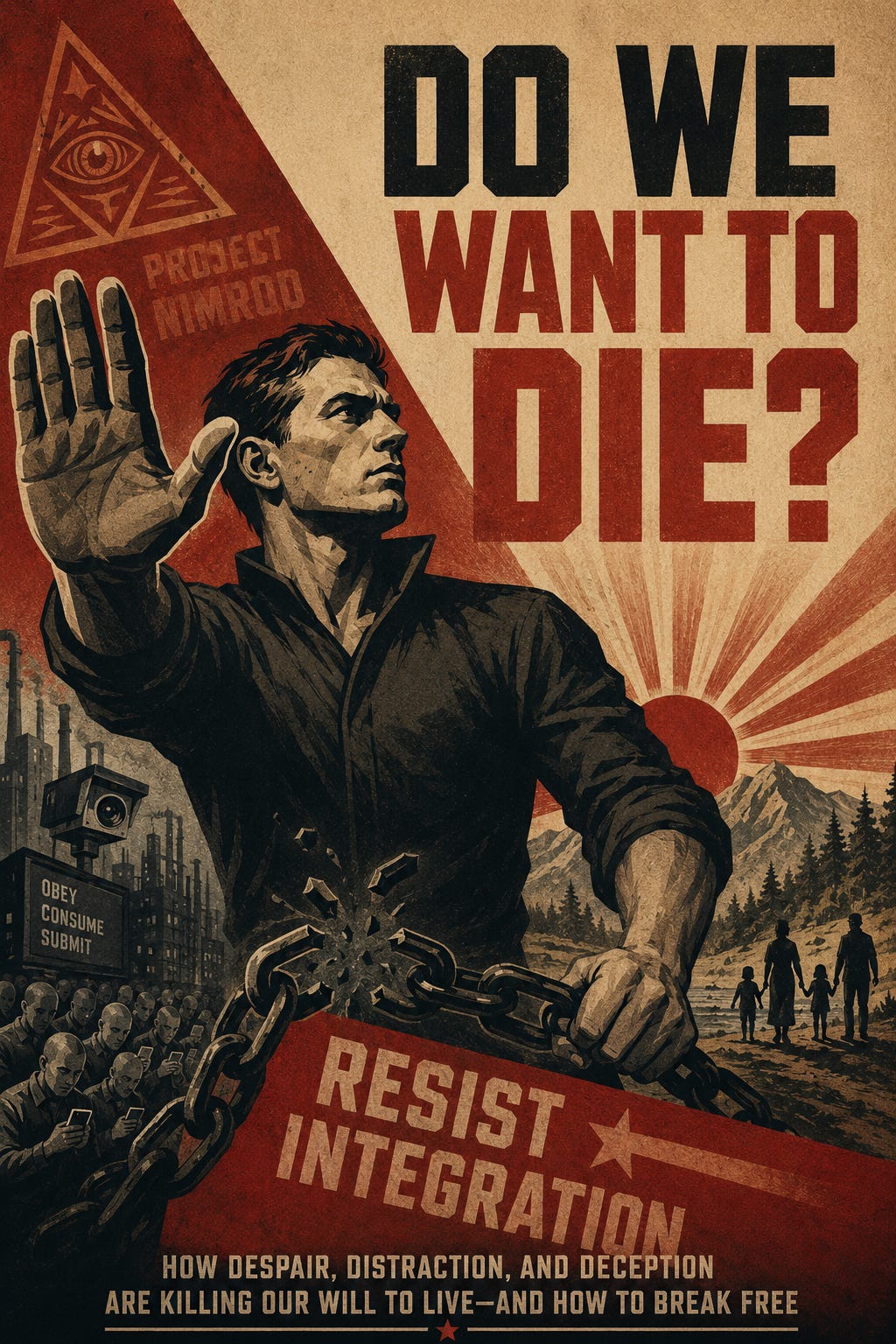
The challenge is that choosing life does not look particularly dramatic. It is not a revolution fought with rifles and banners. It is a revolution of daily decisions. It involves untangling ourselves from systems that profit from our fear, outrage, and distraction. It means choosing courage without any guarantee of success. It means reclaiming responsibility for our families, our communities, and our own souls.
Lately, I have found myself reflecting on what Substack’s feed often reveals about us. Endless scandals. Endless revelations. Endless outrage.
The amount of Epstein commentary alone could fill an entire library.
Were powerful people compromised? It certainly appears so.
Is corruption real? Undoubtedly.
Are there propaganda campaigns, psychological operations, and attempts to manipulate public perception? History suggests the answer is yes.
Yet I cannot help but wonder whether our fascination with these subjects has become part of the problem.
I’m not suggesting these stories should not be investigated. Some absolutely should. But I increasingly find myself asking what happens when awareness becomes a substitute for action.
Jacques Ellul warned that modern propaganda does not merely tell us what to think. It creates conditions under which participation is replaced by psychological involvement. Neil Postman made a similar observation when he argued that entertainment had become the dominant mode of public discourse.
Together, they point toward a troubling reality.
We are becoming spectators of our own civilization.
We consume an endless stream of scandals, crises, disclosures, and predictions. We know more and do less. We react constantly while acting rarely.
There is a subtle comfort in perpetual alarm. If catastrophe is always just around the corner, we never have to confront the ordinary responsibilities that actually belong to us. We can spend years diagnosing the disease while neglecting our families, our churches, our neighborhoods, and our own character.
The result is a strange paralysis disguised as awareness.
I see the writing on the wall. I see the emergence of a technognostic worldview that seeks to solve fundamentally human problems through technological means. I wrote Project NIMROD as an exploration of where those ambitions might ultimately lead if left unchecked.
What worries me, however, is not simply the ambitions of technocrats.
What worries me is that many people who recognize the danger have become trapped in a cycle of doom consumption that leaves them incapable or unwilling to resist it.
There is something latently suicidal about a culture that becomes addicted to despair.
We obsess over collapse.
We binge-watch catastrophe.
We scroll through apocalypse.
We mistake anxiety for vigilance.
At some point, we must ask whether we are informing ourselves or merely entertaining ourselves with fear.
Terror Management Theory proposes that human beings live with a constant tension between our desire for self-preservation and our awareness of mortality. Much of culture can be understood as an attempt to manage that tension. Some seek refuge in politics. Others in entertainment. Others in ideology, technology, or endless distraction.
Personally, I have found my footing in faith.
Not because faith allows me to escape reality, but because it compels me to confront it honestly.
My faith is grounded in lived experience. It is grounded in the difference between who I was before surrendering to God and who I became afterward. It is not something I can place under a microscope and prove empirically. Then again, neither can most of the assumptions upon which modern people build their lives.
At least I am willing to acknowledge mine.
Whatever you believe, I hope you possess a hope that transcends the trends. A hope that survives election cycles, economic turmoil, media narratives, and cultural fashions. A hope rooted deeply enough to withstand whatever comes next.
Do we want to die?
I don’t think we do.
I think we are exhausted.
I think we are frightened.
I think we are overwhelmed.
And I think many of us have forgotten that there is still a world beyond the screen.
As my wife often says, “I don’t want to die before I’m dead.”
Neither do I.
Stay informed. Share what you believe may help others. Speak the truth as best you can discern it. But remember that all the worrying in the world will not change a single thing.
The world that matters most is not the one trapped inside your device.
It is the one right in front of you.
The one where you still possess real agency.
Join me there.
Let’s choose life.
Those who live around me are so lost. I live near a small northern Wisconsin village, in the woods. As I understand it, the village is praising the village idiots for installing the first flock camera. I do not have a lifelog, I mean a facebook account, but I was told the “area talk” account was a buzz with praise. I had to go and see if this was true, and yes the people I talked to thought this was a great idea. I tried to explain the mesh networking that flock, ring cameras, and wifi does, to no avail. “If you are not doing anything wrong”, I was told, this is good to catch all the criminals and drug addicts, I was told by these fear filled creatures. The chemtrails and the screens must be effecting these individuals. The rough and tough sort, you know, fishermen, and hunters live in the northwoods. My friend, bless his heart, is finally understanding after three or four years of me explaining it, backed up by reading material for him. At least he pretends to understand, just to shut me up perhaps…
Some of do want to die. My husband has a rare dementia. Fast progressing. And we pray everyday for god to bring him home. To end his suffering. He prays to. Eventually he will lose all ability to communicate, but he will retain cognition. He will know…
Alzheimer’s would be better . At least he would not know WTF is going on.
Corticalbasal degeneration syndrome.